
The bodies of centipedes and hornets help them survive.
Back to Teacher View
Student View
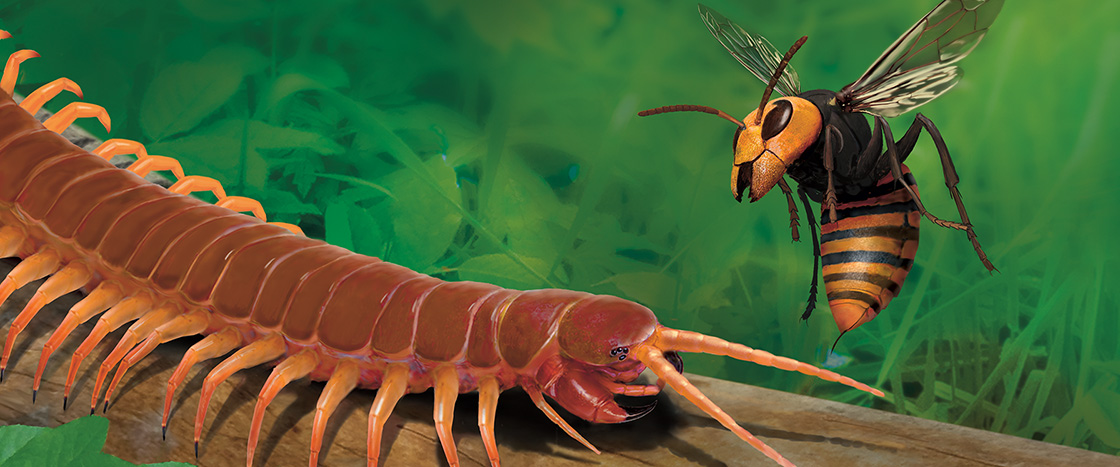
Shutterstock.com (Legs, Front Legs); Kim Taylor/NaturePL.com (Wings); Phil Degginger/Alamy Stock Photo (Stinger)
Who Would Win? Centipede vs. Hornet
What would happen if a centipede met a hornet? What if they had a fight? Who do you think would win?
By Jerry Pallotta | Art by Rob Bolster
From the May/June 2025 Issue
Learning Objective: Students will compare and contrast centipedes and hornets and predict which animal would win in a fight.

Buggy Bodies
Centipede Legs
What’s that crawling along? It has so many legs. It’s a centipede!
A centipede’s body is made up of segments, or parts. Each segment has one pair of legs. Some kinds of centipedes have hundreds of legs!
Centipede Venom
front legs
This centipede is hunting for bugs to eat. It has a secret weapon. Its two front legs are full of venom, or poison.
The centipede catches a bug and stabs it with its front legs!
Hornet Wings
Bzzzz. What is buzzing in the air? It’s a hornet!
Hornets have only six legs. But who needs a lot of legs when you have wings? Hornets fly around looking for food.
Hornet Stingers
stinger
This hornet can eat fruit, but it also eats insects. How does it catch its prey? Hornets have a stinger with venom in it. They can sting many times in a row. Ouch!
What would happen if a hornet met a centipede? Let’s see!
The Fight
Who do you think will win?
Now the centipede and the hornet see each other. They are going to fight.
The hornet can fly. That is an advantage. It buzzes around and stings the centipede! But the centipede has many segments. The hornet will have to sting it many more times.
The centipede is hurt, but its secret weapon is ready. Its sharp front legs are full of venom.
Uh-oh! The hornet flies too close to the centipede. The centipede wraps its legs around the hornet. How can the hornet fight 75 pairs of legs?
Now the centipede stabs the hornet with its front legs. The venom flows, and the hornet can’t move.
The fight is over. The centipede wins!
video
(2)
video
(2)
Activities
(3)
Skills Activities
Answer Key
(1)
video
(2)
video
(2)
Activities
(3)
Download All Quizzes and Activities
Skills Activities
Answer Key
(1)
More About the Article
English Language Arts Focus
Compare and contrast
Science Focus
Animal behavior
Step-by-Step Lesson Plan
Implementation
- Whole group
Pairings and Text Connections
- In this issue: “Meet an Author: Jerry Pallotta”
- From the Storyworks 1 archive: “Alike and Different: The Fastest and Slowest Animals” (February 2024); “Alike and Different: Big Dino and Little Dino” (September 2022)
- Suggested books: Who Would Win? Hornet vs. Wasp by Jerry Pallotta; Are You a Centipede? by Judy Allen
Before-Reading Resources
- Vocabulary slideshow (5 minutes) segments, venom, prey, advantage
- Video: Who Would Win? With Jerry Pallotta (5 minutes) Get to know author Jerry Pallotta
Suggested Reading Focus
Compare and contrast; predicting (20 minutes)
- Ask children if they are familiar with the Who Would Win? book series. Explain that in the series, the author describes two different animals and imagines what a fight between them would be like. Say that this article is set up in the same way—students will learn facts about a centipede and a hornet and get to predict which would win in a fight.
- Read “Buggy Bodies,” stopping at the end of each section to check comprehension of the text. Then look at the accompanying picture. What does the picture tell students?
- When you’ve finished, ask students what they learned aboutcentipedes and hornets. Create a T-chart to record what they remembered from the text. Ask students to predict which animal they think would win in a fight. Why do they think that?
- Then read “The Fight.” Was the class’s prediction correct?
After-Reading Skills Practice
- Skills: Prediction/key details; writing/drawing; compare/contrast (15 minutes)
Text-to-Speech